
Field note
The map nobody publishes.
Every figure in the film, and the record behind it. Nothing is asserted here that the film does not show, and nothing the film shows is missing from this page. Both are generated from one file.
The count is a floor, not a census. It is where volunteers have looked, not where cameras are. Coverage is dense where people mapped and empty where nobody did, so every figure on this page says mapped, never installed.
The standard
What this page will and will not say.
The film runs on two kinds of number, and they do not carry the same weight. Every row below says which kind it is.
Measured, or reported.
A measured figure is one this pipeline computed from open data named on this page, and anyone with the same snapshot can recompute it. A reported figure is one a named publication reported, on a stated date, at a link you can open. No row blurs the two.
Nothing beyond the source.
A citation supports what its row says and no more. Where the wording carries the weight, the quote is verbatim, short, and attributed on the same line, so the reader can see who said it rather than inferring it.
Both accounts, where they conflict.
Where a company disputes a report, the dispute sits next to the report, not further down the page. Where a court ruled against the argument this piece describes, the ruling is on the rail. A record that only ran one way would be advocacy.
What was left out is listed too.
Six figures were available and are not used. Each is named below with the reason it was refused, because a refusal is part of the method and not an apology for it.
The film and this page are generated from the same events file, so neither can carry a figure the other lacks. Where the film shows a percentage and the frame had room only for the result, this page also publishes the counts underneath it, so the arithmetic closes somewhere a reader can see it. Optera publishes this page; it is a field note against the same rule the rest of the site runs on, which is set out in the seam.
The plate
Drawn only by cameras.
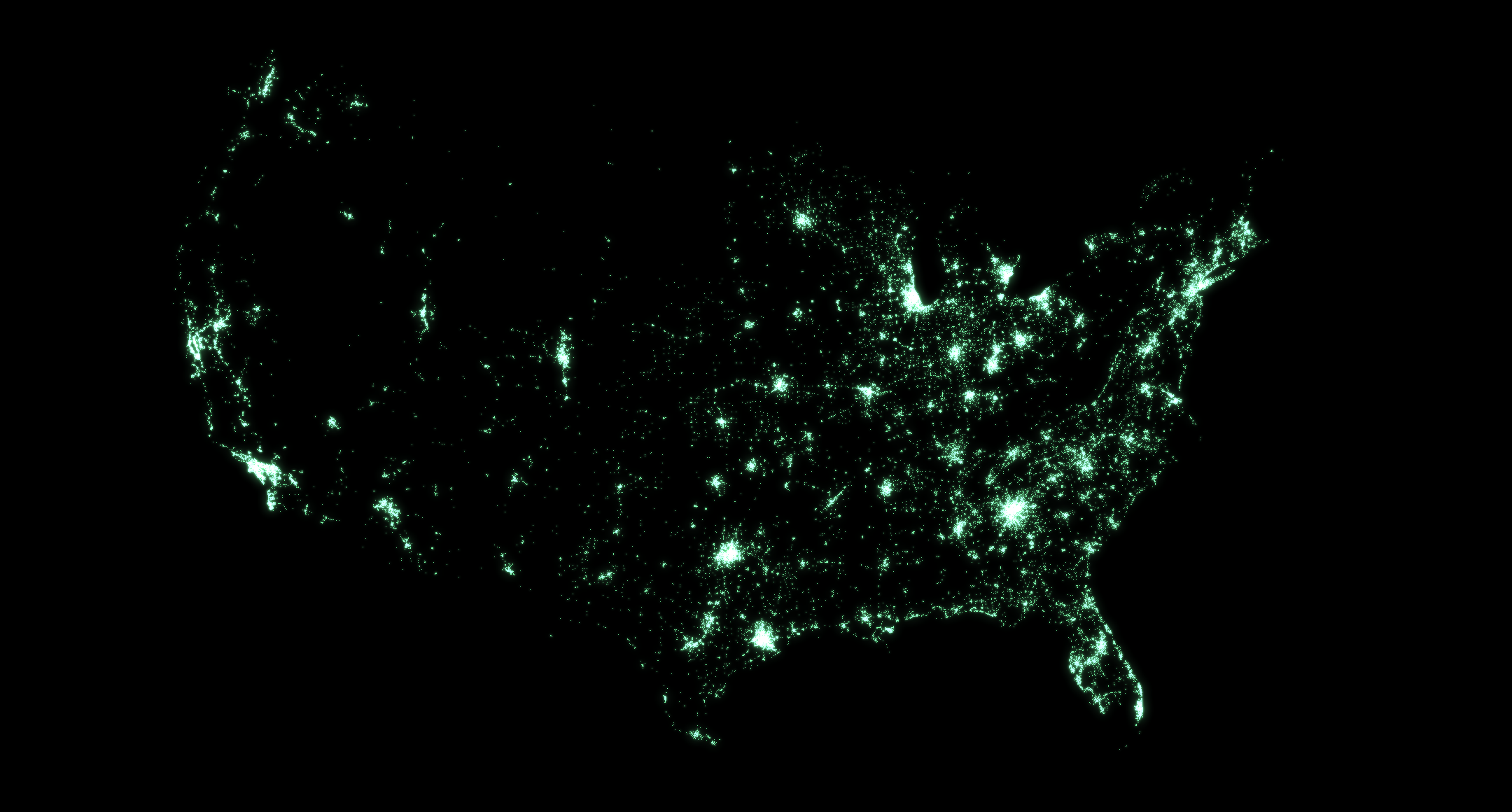
122,721 mapped camera positions, equal-area projection (EPSG:5070). No coastline and no state boundary is drawn: the outline is entirely cameras. Camera locations © OpenStreetMap contributors, licensed ODbL. Snapshot 2026-07-31.
The count
How the count was made.
A fetch envelope is a rectangle, and a rectangle over the lower 48 also contains southern Ontario and a band of northern Mexico. The operator tags gave it away: Ontario's transport ministry surfaced in the ranking.
The working
Where 86.2% comes from.
The film shows three numbers: 122,721 mapped, 102,393 naming Flock, and 86.2%. The two counts in the middle of that arithmetic did not fit a frame. They are here, so the share can be checked instead of trusted.
The rule that sorts them is mechanical, and worth stating exactly. For each node the pipeline reads the first tag present among manufacturer, brand and operator, in that order. If that value contains the string flock, case-insensitively, the node counts as naming Flock. If it holds anything else, it counts as naming another maker. If none of the three tags is present, the node counts as naming nobody.
Two figures on this page say Flock and count different things. 102,393 is the rule above, across all three tags. 2,197 is the operator ranking further down, which reads the operator tag alone. They are separate measurements of a volunteer field, not two attempts at one number, and neither is a count of cameras any company owns, sells or operates. They should not be subtracted from each other.
A tag is what a volunteer typed. It is not a company disclosure and not a public register, and this page reports what the tags say rather than what is installed. As an independent check on the same open data, a 2026-07-30 report put roughly 119,000 mapped roadside readers with Flock at about 83%, close to what this pipeline measured. It is cited to corroborate the method, and is not the source of any figure here. deflock_share
The ledger
Every figure, and what it rests on.
The four steps of the recount are above. These are the rest, in the order the film reaches them. Each key resolves to the source list.
Measured from the snapshot
Every row in this group is counted after the country filter, from the 2026-07-31 snapshot. An operator row counts what volunteers typed in one tag. It is not a statement about who owns, installed or runs the camera.
Reported by others
The quotations in this group are reproduced for reporting and comment, each attributed to a named publication with the date it was published and the date it was retrieved. The company's stated objective is reproduced as its own goal, verbatim and dated. It is neither endorsed nor refuted here. The warrant row is scoped to that one query, which is what the film says of it. It is not a claim about what any network requires in general.
The company card
Both rows are on screen in the film's company card. They are reported facts about a company and the people who founded it, named because the film names them, and nothing is inferred from either list. An investor is not a party to anything else on this page.
One dot per camera
The number, drawn.

One dot per camera, 122,721 of them. The last row is short because the number does not divide evenly, which is the point of drawing it this way. Camera locations © OpenStreetMap contributors, licensed ODbL. Snapshot 2026-07-31.
The rail
Two tracks, one chronology.
Deployment is what the company announced, on the day it announced it. Oversight is what public bodies found and did. The oversight track is empty until 2025, which is the point and is not padded to look busier.
The 2025-10-07 row carries the company's answer to the 2025-05-30 row. In the film the two sit together in the search scene rather than on the rail; on a page they have to sit together too, or the rail states an allegation and leaves the response somewhere else. Both are drawn from the same two EFF pieces the film cites, and the one row on this rail whose citation is incomplete is marked as such rather than dressed up.
The refusal
There is no time axis on the map.
OpenStreetMap records the date a mapper added a camera, not the date anyone installed one. Real installation dates exist on 26 of the 123,601 nodes returned, in six incompatible formats, one of them a month that does not exist.
A second candidate, the source dates in EFF's Atlas of Surveillance, clusters so hard that a single records release supplies 45% of its rows on one day. Animated, either one shows research activity wearing a deployment curve's clothes. So the map is held at one snapshot, and the film says so on screen.
Excluded
Figures that were available, and are not used.
Recording a refusal is part of the method. Each of these was reachable, and each was left out for a reason that is stated rather than implied.
An $8.4B valuation
An $8.4B April 2026 valuation is widely repeated and is not used here. The sources we could trace for it are a paywalled Axios Pro report we could not read, and secondary-market platforms that quote prices for exposure to the shares being valued. Our judgment, on those disclosed facts, is that neither is an independent primary source for a valuation.
The series therefore ends at the $7.5B the company itself announced, which understates the current figure. Understating is the safe direction. Checked 2026-07-31.
Aggregator dates
One aggregator dates the $275M round to September 2025. The company's own release and the wire service carrying it both date it 2025-03-13, six months earlier.
Where an aggregator and a primary release disagree, the primary release wins and the aggregator is not cited. Every funding date on this page traces to a company release or a wire service carrying it.
The immigration lookup count
A figure of more than 4,000 lookups with search terms such as immigration, ICE+ERO or ICE WARRANT between June 2024 and May 2025 appears in coverage of the Illinois audit.
It is excluded. The Secretary of State's own site was unreachable from this machine across repeated attempts on 2026-07-31, so the primary release could not be read, and the number could not be traced past secondary summaries. The audit's conclusion is used instead, which several named outlets report consistently.
Camera counts by company
No company's own current camera total is asserted here. Reported figures range from 80,000 to 120,000 depending on the month and on whether PTZ cameras are counted alongside ALPR.
The piece uses its own measurement of the crowdsourced map instead, which is a number this pipeline produced and can defend, and labels it a floor.
Crime reduction
Flock's crime-reduction claims and the studies disputing them are both omitted. Adjudicating them is beyond what this piece can source, and quoting either side without the other would be advocacy.
The 25% objective in the pitch card is different in kind: it is reproduced as the company's own stated goal, verbatim and dated, not endorsed or refuted.
A cancellation ticker
A scrolling roll of every city that ended a contract, with a running total, was considered and cut. The circulating totals of thirty-plus cities trace to advocacy trackers whose per-city sourcing we could not verify row by row, and a counter on screen asserts the total it reaches.
The rail carries only the cancellations verified against named outlets, which understates. If each row is ever verified individually, the ticker becomes buildable.
The source list
Every key, resolved.
Each entry carries the link, the publication date where one is stated, the date it was retrieved, and what it supports.
Rights and corrections
What this page claims, and what it does not.
No generative AI produced any pixel, sample or figure in the film. Every measured number on this page is computed from the cached source data by the same pipeline that renders it, and every reported number carries the publication that reported it.